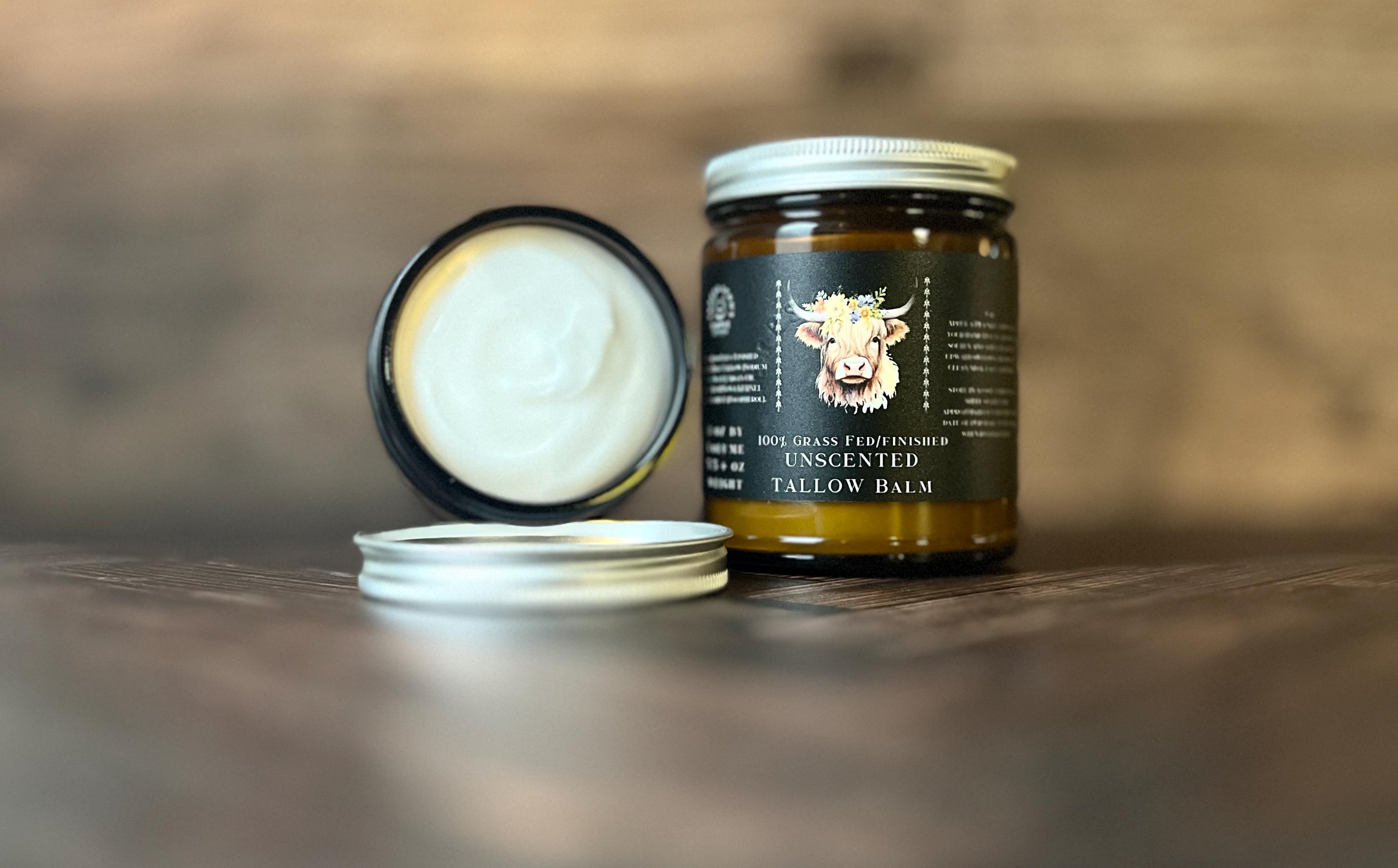
Why We Use Grass-Fed + Grass-Finished Tallow (and why all tallow isn’t always the same)
Once a staple in many your Grannies Kitchen, Tallow is making a comeback, but do you know why?
Tallow skincare is having a moment. And honestly? I get it. When it's made well, it's rich, comforting, and wildly effective for dry, cranky skin. But here's the part that gets skipped in a lot of listings:tallow isn't a single, consistent ingredient.There's a big difference between commodity tallow (the kind that comes from large-scale, mixed sourcing) and grass-fed + grass-finished tallow (the kind I choose for my products). This isn't about fear. It's about starting with the best possible base.
Tallow contains monounsaturated and polyunsaturated fats, which are considered healthier. Conjugated linoleic acid (CLA) is one polyunsaturated omega-6 fat found in animal fats and linked to potential health benefits. CLA has anti-inflammatory benefits that help lock in moisture and reduce oxidation, which, along with the fat-soluble vitamins in beef tallow, may improve skin’s elasticity and overall healthy appearance when applied topically.
The two types you'll see online
1) Commodity / bulk tallow - Discount stores-lower prices
This is the most common kind used in mass-market or bulk-made products. It's typically rendered from conventionally raised cattle and sourced through large suppliers.It can be perfectly usable. But it's often:
- Mixed-source (multiple farms, multiple diets)
- Less transparent (hard to verify how the animals were raised)
- Less consistent from batch to batch
2) Grass-fed + grass-finished tallow - Handmade Luxury
This means the animal stayed on pasture and finished on grass rather than being switched to a grain-heavy finishing diet.That finishing period matters. It's one of the reasons I don't treat tallow like a commodity ingredient.
Why I choose grass-fed + grass-finished (in plain English)
1) Because tallow is the foundation
In a tallow balm, the tallow isn't a supporting characteristic, the main ingredient. If the base isn't excellent, nothing else can make the product feel truly luxe.
2) Because sourcing affects the starting fat
Many conventionally raised cattle are finished on grain-based diets. That doesn't make the fat bad but it does mean you're not comparing apples to apples when you compare it to pasture-finished fat.So when you see tallow trending everywhere, it's worth asking: what kind of tallow is it?
3) Because consistency matters (and you can feel it)
When you make products in small batches, you learn fast: ingredient quality shows up in texture, scent, and performance.Grass-fed + grass-finished tallow gives me a more consistent base so your balm doesn't feel like a science experiment from batch to batch.
4) Because yes it’s expensive, and yes it’s worth it
Grass-fed + grass-finished sourcing costs more. Full stop.But I'd rather charge what it costs to do it right than cut corners on the one ingredient that makes tallow skin care special.
I’ve been doing this before it was trendy
I've been making tallow products long before some internet expert told America to fry everything in tallow. My family is from the South, tallow and lard were pantry staples. I learned later in life what a lot of us learn the hard way: inputs matter. What an animal is raised on (and how it's finished) affects the ingredient you end up using whether that's in a skillet or in a balm.
What to ask before you buy a tallow product
If you're shopping tallow skincare (especially on Etsy), here are the questions that actually matter:
- Is the tallow grass-fed + grass-finished or commodity/bulk?
- Can the maker tell you where it's sourced?
- Is the product consistent in texture and scent from batch to batch?
- Are they making realistic claims (not miracle cures)?
My promise
I'm not here to scare you into buying from me. I'm here to make products the way I'd want them made for my own home: thoughtful ingredients, honest labeling, and no shortcuts.If you ever want to know more about what's in a product why I chose an ingredient message me. I'll happily nerd out.